Lowering The Barrier To Entry For Young Market Goers
I'm a ceramicist who noticed a pattern at every art market, young people wanted to support local artists but couldn't always afford to. So I set out to see if I could make my ceramic pieces more accessible to people of all ages and backgrounds.

Art Market Observations
I have done a few markets as a ceramicist and most of the environments I have participated in catered to folks in their 20s and 30s. In this economy, people my age can barely afford groceries and rent let alone pieces of art.
These are some observations I had as a vendor:
Young people want to shop small and local. I have noticed that trend across social media, as a vendor at art markets, and through my own friendship circles.
My most popular item is both my smallest piece (a ring dish) as well as my cheapest piece ($15)
Items that do well at art markets targeted at younger people are often pieces that are on the cheaper end (between $3-$25)
Trinkets, prints, stickers, jewelry, etc.
Hypothesis & The Beginnings Of My Magnet Idea
I once worked in a research lab so of course I had to put my science skills back in motion for this. My hypothesis was as follows:
"I believe that young art market visitors are interested in supporting local ceramicists but are deterred by higher price points. By introducing a small, affordable ceramic magnet, I expect to convert browsers into buyers which we will measure by sell-through rate of an initial test batch over a 21 day period."
Why magnets?
They are small meaning I could use recycled scrap clay to make them (yay sustainability) and they are easy to carry around in a pocket/purse!
They would be cheaper to produce (less time sculpting/throwing and less clay)
They are functional! Who doesn't love something that is both cute and practical?
Considerations For Myself (The Artist)
I wanted to test out a few things with my first batch of magnets
Shape & Thickness: I started out with a standard circle cookie cutter about 2 inches wide knowing that the clay would shrink about 12% from start to finish, I also wanted them to be lightweight enough for a small magnet to hold them up without being too thin and potentially breaking
Design: I am known for my hand-painted work and although it sets me apart it also means my pieces require more labor and are sold at a higher cost. For this reason I decided to sketch out a few simple designs that I could do in 10-15 minutes vs multiple hours. I also decided to keep everything in 1 color (I went with dark blue) so that I wouldn't need to spend time switching colors, cleaning brushes, etc.
Timeline & Location: I conducted my test at my local pottery studio in Laguna Beach from July-August which is during our tourist season. I figured making "Laguna Beach" themed magnets would be perfect for this test batch because it catered to both locals and tourists.
The Test
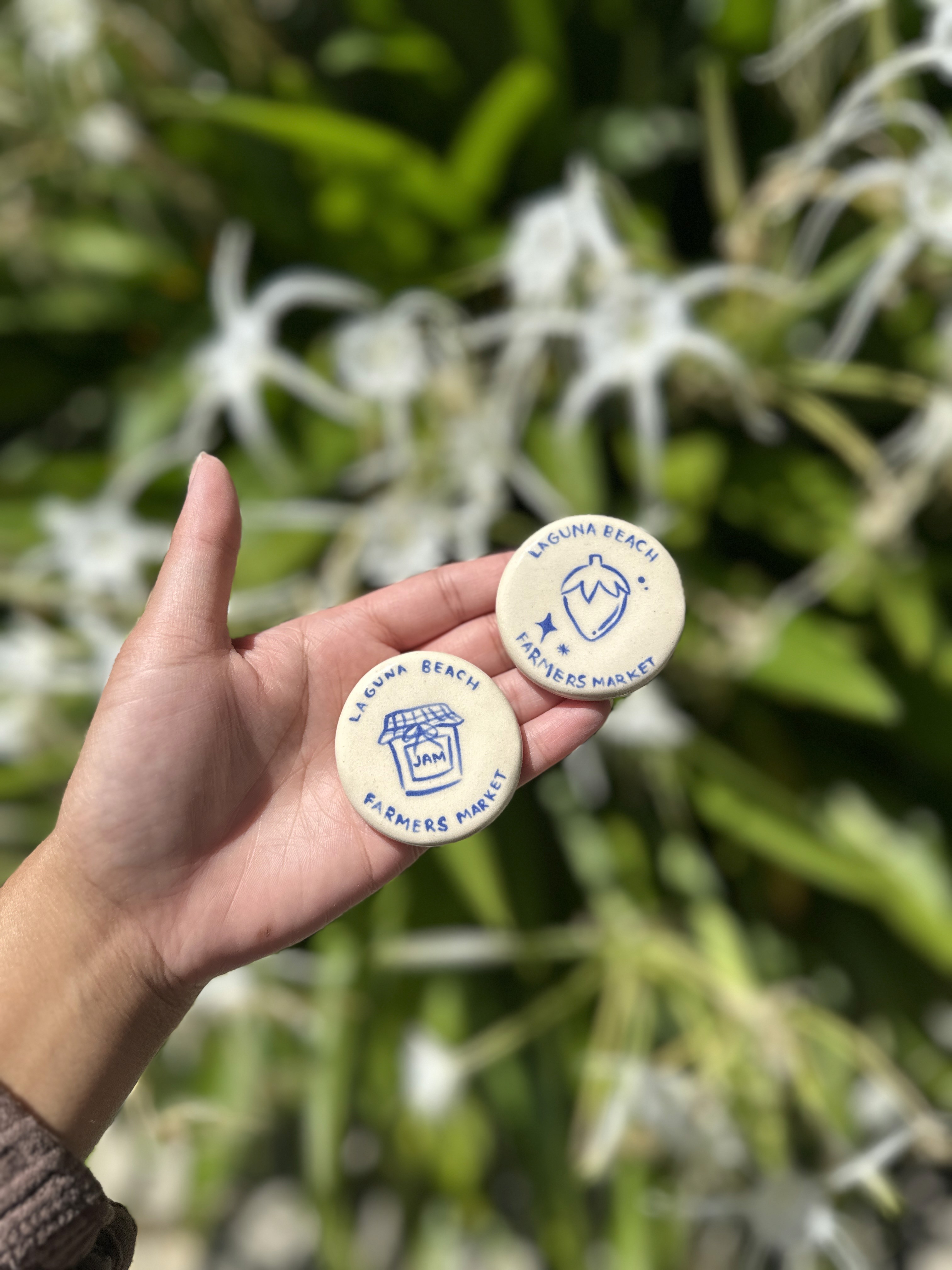
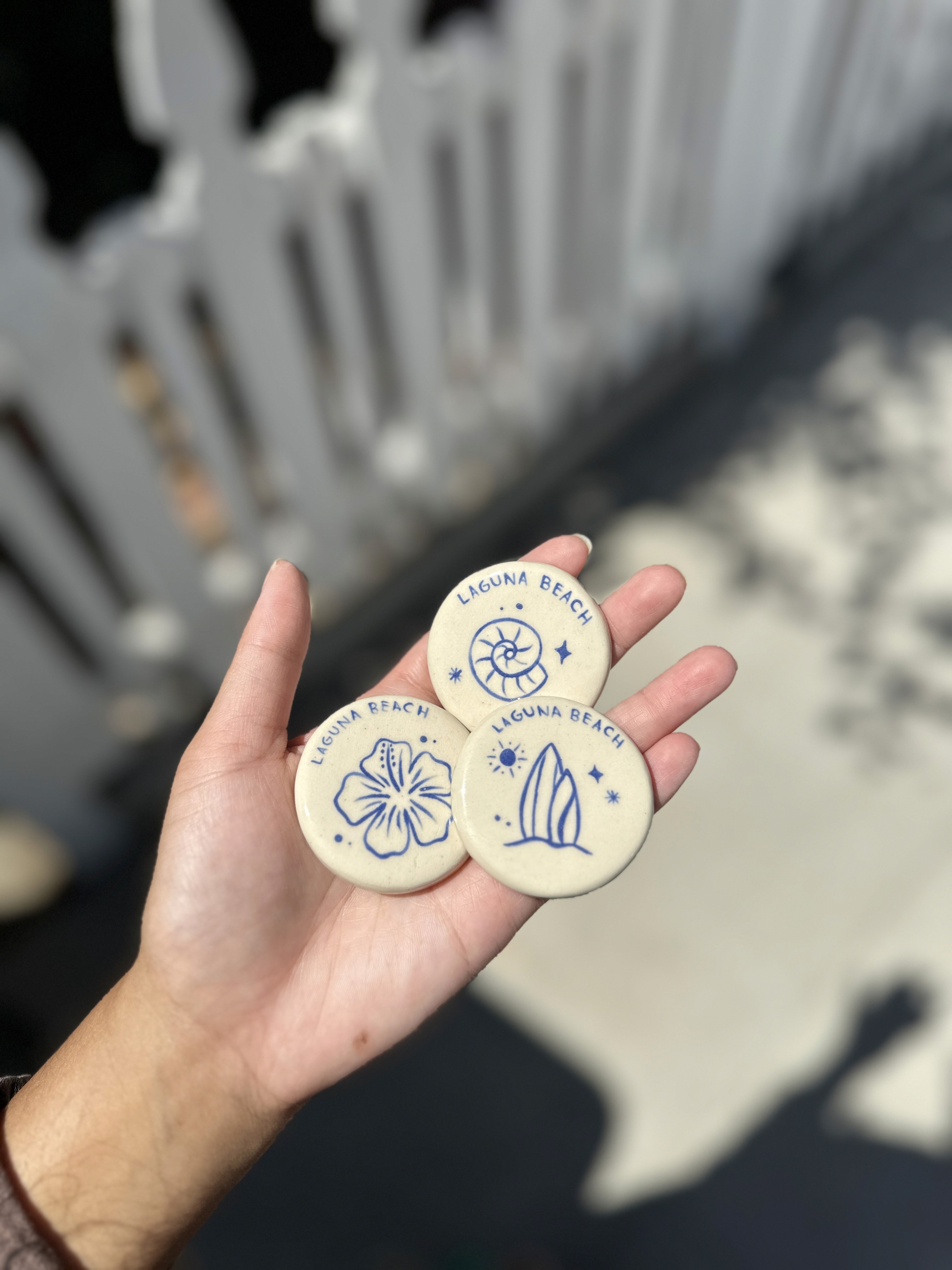
I started out my test with a batch of 8 magnets with 5 different designs. They were all circle shaped, blue underglaze, and had either "Laguna Beach" or "Laguna Beach Farmer's Market" written on them with a simple design.
I kept all the magnets in a bowl that I made, with a small handwritten sign stating " Laguna Beach magnets for sale! $8 or 2 for $15" From previous markets I learned that people love bundles so I normally offer a bundle deal of some sort for most of my pieces.
I then placed the magnets at our front desk which is the first thing folks coming off the street see when they stop by the studio.
Findings
After 3 weeks at the studio 7 out of 8 magnets sold, 2 sold as a bundle, and there were at least 20 interactions with the magnets that I witnessed during that time. The age range of folks who interacted with the magnets varied significantly but for folks who purchased almost all were in their 20s and early 30s as predicted!
What's Next?
My hypothesis was successful upon the first test and now that I have gathered some initial insights I have more ideas to test out. Here's what I am considering for the future:
Display: I had all the magnets in a bowl so only the top few were displayed while the others were hidden underneath. Would people be more likely to purchase if they could see all the magnets at once, as well as the magnets in action? My next test will have them on a magnetic display board. My prediction is that the ability to interact with the pieces, test out the strength of the magnet, and seeing all the options at once will garner more interest from people as they are shopping.
Design: How would other color options do? I would like to test out the same design in different colors. I would also like to test out magnets with no words only an illustration. I am curious to see if people liked the fact that the magnets said "Laguna Beach" or cared more for the illustration. If the magnets sell without the words then I can cut down on hand painting each letter.
Conclusion
Bringing design thinking into ceramics has made me much more intentional as a maker and although an in depth analysis on magnets may seem random, it shows a few key things about me:
I care deeply to know and understand the people I am designing for
I know how to turn insights into actionable change and gather feedback for future innovations
I learn and adapt quickly and understand product strategy
Return Home